

Summer is an important time for teen workers, as some make their moves into employment after finishing their education and others seek temporary work to build a resume and earn money, often for the first time. Entering the summer of 2026, the market is in a state of flux for young workers. The unemployment rate for teens has been increasing since 2023, making finding a summer job more challenging in 2026 than it has been over the last few years.
Over the past few years, teen labor force participation has dropped, meaning a smaller percentage of teens are looking for work or working.
Despite these labor market challenges, a larger share of Minnesota teens is engaged in the labor force compared to teens around the U.S. This is great news for employers who rely on these workers in a range of industries including food service, retail trade and amusement and recreation, among others.
Due to the more challenging job market, teens who want to work this summer should start looking now, apply to many jobs and be persistent.
Current Teen Employment Situation
Youth unemployment spiked in the early days of the pandemic, as younger workers were more likely to be employed in customer-facing service industries such as retail and food service, sectors that were particularly hard-hit by the pandemic response. Recovery was quick for the teen labor force, however. As Figure 1 shows, pandemic-era teen unemployment peaked in January of 2021 at 13.8%, and by December 2021 that number had dropped to 5.4%, matching the lowest annual average on record (dating back to 2001).
Post-pandemic, the teen unemployment rate remained low, hovering between 5% and 8%, low by historical standards as the green line in Figure 1 shows. However, it rose throughout 2025 and early 2026, reaching 13.2% in March of 2026. While this might feel discouraging for teens who want to work this summer, Figure 1 shows that these higher levels of teen unemployment are in fact more typical and that there are still many jobs available for teens this summer.
Figure 1: Teen Labor Force Indicators, Minnesota, 2001 to 2025, Annual Averages
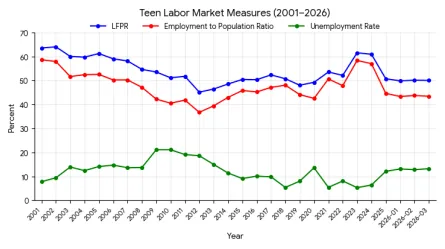
Blue line = Minnesota Teen Labor Force Participation Rate
Red line = Minnesota Teen Employment to Population Ratio
Green line = Minnesota Teen Unemployment Rate
From 2024 to 2025, the rising unemployment rate pushed the number of employed teens down by 24,000 over the year, while the number unemployed increased by 7,500 over the same period in Minnesota. The teen labor force participation rate dropped ten points between 2024 and 2025, from 61% in 2024 to 51% in 2025 on an annual average basis, an unfortunate consequence of a cooling labor market. Teens, especially younger teens, are sensitive to how easy or difficult it is to find a job and may opt for other after school or summer activities if they don’t find one quickly or perceive that they may not be able to find one.
Teens held 7.1% of all jobs in Minnesota during third quarter 2025, up from 7.0% in 2024 but down from 7.3% in 2023 and 2022 (Minnesota’s Quarterly Employment Demographics data). This is a bit lower than average over the last two decades where the share ranged from 6.4% (2011) to 9.2% (2005).
Teens earned a median hourly wage of $16.51 per hour and worked a median of 135 hours (total hours worked during the quarter) during third quarter 2025 up from $16.15 during the same period in 2024. This increase of 2.2% over the year was the lowest since 2013, and a bit below inflation. The number of hours worked was almost unchanged, down only one hour over the quarter from 2024. The teen hourly median wage in third quarter 2025 was 61% of the median wage of all workers, similar to the previous 3 years.
Definitions of Labor Force Indicators
- Labor Force Participation Rate: The share of the population (in this case teens age 16 to 19 in Minnesota) who are either working at least one hour for pay the week of the survey, or who were actively looking for work by sending out resumes, filling out applications, and/or meeting with potential employers.
- Employment to Population Ratio: The share of the population (teens age 16 to 19 in Minnesota) who were working at least one hour for pay during the week of the survey.
- Unemployment Rate: The share of the population (teens age 16 to 19 in Minnesota) who were actively looking for work by sending out resumes, filling out applications, and/or meeting with potential employers.
These labor force measures are calculated from responses to a monthly, nationwide survey of households called the Current Population Survey. In Minnesota 12-month moving average data are used because of the small sample size. December 12-month moving averages represent the midpoint of each year and are what is displayed in the graph.
Where Teens Find Jobs
Numerous industries fill their workforces with a significant number of teens, especially in the summer months. As Table 1 shows, teen share of total employment was 7.1% in third quarter 2025, which represented an increase over the previous year, from 7.0% in Q3 2024. It was also an increase over Q1 2025’s 5.6% of total employment, a common trend as teen employment grows rapidly following the end of the school year.
Table 1: Teen Share of Industry Employment, Hourly Earnings, and Hours Worked, Top 5 Industries, Minnesota, Third Quarter 2025
Industry |
Share of Industry Employment
|
Share of Industry Employment
|
Median Hourly Wage ($) |
Number of Hours Worked |
| Total, all industries |
7.1 |
7 |
$16.51 |
135 |
| Accommodation and Food Services |
25.8 |
25.5 |
$15.82 |
107 |
| Arts, Entertainment, and Recreation |
19.5 |
19.2 |
$15.12 |
96 |
| Retail Trade |
16.6 |
16 |
$16.15 |
153 |
| Agriculture, Forestry, Fishing, and Hunting |
11.1 |
10.4 |
$15.91 |
120 |
| Other Services |
7.9 |
7.8 |
$15.97 |
122 |
Source: Quarterly Employment Demographics, DEED. All columns Q3 2025 unless noted.
While teens comprised just 7.1% of all employment in summer 2025, they made up a very large segment of the workforce in a number of industries. In Accommodation and Food Services, they were over a quarter of the entire workforce, and teens represented over ten percent of the workforce in four industries. All of the top five industries for proportion of teen employment also posted increases in percentage of teen employees from summer 2024 to summer 2025.
Of the five industries with the largest share of teen employment, median hourly wage and median quarterly hours worked were both highest in Retail Trade, at $16.15 and 153 hours, respectively. The lowest for both marks was Arts, Entertainment and Recreation, at $15.12 and 96 hours.
Other sectors with large (>5%) proportions of teen workers in the summer of 2025 included Public Administration (6.8%), Administrative and Waste Services (5.3%) and Construction (5.1%). Of those, the highest median wages and quarterly hours were in Construction, which paid $20.93 an hour with an average of 288 hours worked.
2026 Outlook
There are undeniable signs that the labor market is weakening across the board. As of February 2026, Minnesota’s unemployment rate has risen to 4.5%, the highest since January 2021, and job growth has slowed to 0.4% in 2025 and further to 0.2% over the year in February, the lowest it’s been since 2021. Nationally, over the year job growth has been negative since November 2025. Teen labor force indicators are reflecting this overall weakening, with higher unemployment, lower employment and a lower labor force participation rate.
Despite this weakening in the economy, there will continue to be many opportunities for teens who want to work. But they should start looking early and be persistent. Moreover, they should remain flexible about where and what types of jobs they look for. Neighbors, relatives and community members may not only be good sources of leads but may also provide opportunities for teens to flex their entrepreneurial muscles over the summer by providing services like yard work, house cleaning and babysitting. A job like personal care attendant can provide an excellent opportunity to gain experience in health care and babysitting can provide experience in teaching. Get creative about how you think about your summer job opportunities!
Tips for Recruiting Teens
Teens can be extremely reliable and flexible and quick to learn new skills. As a result, many employers value them highly as workers. Beyond meeting immediate staffing needs, employers should also think of summer hiring as an opportunity to build their workforce pipeline. Helping teens see your industry as a viable career option can help you in the long run. Offering summer internships, apprenticeships, or on-the-job training opportunities to teens can help build a pipeline of workers for your industry and help you establish relationships that may support your business in the future.
Here are some tips for recruiting teen workers. Teens have never known a world without the World Wide Web. The first place many will go to find a job is the internet so make sure that you have an attractive website, on-line job application, or easy instructions on how to apply, or that you're posting jobs on job boards like CareerForce.MN.gov or other sites that teens are likely to find.
Ask your teen workers to tell their friends that you're hiring. Teens are natural networkers and can help you get the word out about open positions.
Make sure that you're adhering to child labor rules and keeping your teen workers safe. Rules vary for kids ages 14 to 17. You can find information on the Minnesota Department of Labor and Industry website.
Tips for Teens Looking for Work
If you are new to the job application process, here are some tips for you. Mostly you'll be filling out applications, but it can be helpful to put together a one-page resume. A resume should include how to contact you, any jobs both paid and unpaid you've had, volunteer experience, such as helping a family member or friend or babysitting your sibling or neighbor, where you go to school, or your school history. Then have someone read it and give you feedback. Make sure there are no spelling or punctuation errors and make it look nice. Having a resume will also help you fill out job applications by making sure you have all the information you need handy.
Have a list of one to three references that you can give potential employers. If possible, the list should include someone you've worked for, even if you didn't get paid or were one of many volunteers. It should have names and emails and/or phone numbers.
Do your research on the business so that you know what they sell, make, or provide and so that you have some idea of what your role might be or how you could contribute. Also, if possible, see how people are dressed on the job and dress that way, making sure you look neat and professional for the interview.
Lots of teen jobs are located outside of the center cities so it can be hard to find work if you don't have access to a car or someone who can drive you. Think about your options for public transit. What businesses, entertainment sites, and shopping districts can you get to? You might need to cover the bus/train fare out of pocket until you get your first paycheck so make sure you have some money saved.
To search for job openings, ask family and friends if they know of companies that are hiring, and look for help wanted signs in your neighborhood and other places you often go.
In an interview, let the employer know that you are reliable, show up to work on time, every day, ready to work, and that you are eager to learn.
Be persistent. Apply for lots of jobs. Almost no one gets the first, second, or third job they apply for. Keep trying. You can ask employers who turned you down to give you feedback. They may (or may not), and it may be helpful (or not), but it is worth asking and shows that you're serious about finding a job.
If you get multiple job offers here are a couple of things to think about: Does it seem like a good place to work? Will you learn anything new? Which will look best on your resume in the future? Can you reliably get there on time for each shift? Which job pays the most, and is there any room for negotiating wage? It doesn't hurt to ask, and the employer might say yes.
Resources for Teen Job Seekers
For teens who plan to go on to higher education, the military, or another post-high school option, just getting work experience and earning a paycheck may be enough.
For teens who plan to enter the workforce directly after high school, finding a job with on-the-job training or in an industry in which you see yourself working in the future could provide a road map to financial independence after high school.
If you fall into this category, the resources below are especially important for you to spend some time exploring. Use your summer down time to learn about occupations that don't require college but pay a good wage. Look for paid or unpaid apprenticeships or internships in occupations that interest you. Be open to any training that an employer or program offers so that you can gain specific work skills. Try to figure out how to tie your career interests to school so that you can spend your junior and/or senior year taking classes that support that interest. Most importantly, reach out to counselors and teachers at school and adults in other areas of your life who might be helpful, and ask for advice and help figuring out your next step. Finding a career path takes work but it pays off in the end.
Below are some resources to help teens find employment and explore careers:
- Search job postings by location, employer name, job type and more at CareerForce.MN.gov/job-search
- CareerForce.MN.gov has a simple set of steps for young people to take whether they want to find employment now or plan for their future career.
- GetMyFuture is a great place for you to learn about finding a career, getting job experience, and getting a job.
- Learn about resources for teens and young adults who have dropped out of high school or are in danger of doing so or who have other barriers to employment. This website can help you connect to programs and people who can help you with your next step in life.

